-
-
RIP Philippe Gaulier: The cardinal sin, the unforgivable, was to be boring. Like a pharmacist (his paternal grandfather was one. A really boring guy). Or a hairdresser. No one who was happy being boring should try to be a clown.

-
-
-
Oliver Burkeman: You have the option of living with vastly more creativity and calm than the anxiety-merchants would have you believe – provided you can summon the strength of mind to screen them out. [I love the phrase “inner clench” Oliver uses!] …
I think this is the best way to stay calm and level-headed during a moment of speculation about technological change that will, I’m pretty sure, come to seem embarrassingly hyperbolic. Even if I’m wrong about that, I think it’ll still be the way to produce the kind of work people will pay you for, because the work will come from aliveness, which is ultimately what people most want to feel and to connect with. And even if I’m wrong about that – which I highly doubt – it’ll still be the way to have spent your time on earth living a fuller, more vibrant and absorbing life. Really experiencing, that is, the trembling and poignant and mysterious reality of this uncertain state, instead of clenched and scared and fighting it every step of the way.
-
Esau McCaulley: I am a pastor and a public theologian. By vocation, I have a duty to hope. To hope, as a Christian, is never to concede that wickedness must be the end of any person’s — or any nation’s — story. To hope does not imply accepting a false peace that laments divisions without naming the evils done. Instead, hope demands a certain doggedness, a refusal to let go. The same patience that God showed me must, in principle, be available to others.
-
Music is for everyone
-
The egg came first: There was an actual, historic chicken that ran around like a chicken with its head cut off. In the 1940s Mike, a Colorado rooster on his way to the dinner table, survived an incomplete decapitation that left enough of his brain stem intact that he remained partly functional and could run around. During the eighteen months he lived in this condition, his owner toured the United States and exhibited him as a sideshow attraction.

-
Adam Kirsch: Telling someone to love literature because reading is good for society is like telling someone to believe in God because religion is good for society. It’s a utilitarian argument for what should be a personal passion.
-
Path (2014) by Charles Choi

-
When the Spirit must practice his scales of rejoicing Without even a hostile audience, and the Soul endure A silence that is neither for nor against her faith That God’s Will will be done, That, in spite of her prayers, God will cheat no one, not even the world of its triumph.
-
Why I Keep Returning to Middle-Earth: That the same Middle-earth is filled with sorrow and unrecoverable loss — that the work itself seems battered by time and change — only helps us believe that perhaps the sudden turn to the good may happen in our own fallen existence. A light springs in the shadows, a single star gleams high above the cloud-wrack, and we catch a glimpse of the joy beyond the walls of the world because it is real. We see a path toward a place not free of sorrow but in which tears are blessed without bitterness because beyond the circles of the world, there is more than memory. We find hope.
Art by Pauline Baynes

-
Brett Paesel: Keep your wimpy stories about falling in love at first sight and how perfect it all went. First of all, probably not true. But second, where’s the triumph, the vindication, the B-plot and the poetic justice? … These days, when I see them [the author’s parents] in my mind, they are almost always together — leaning into each other conspiratorially, as if guarding the precious and overlooked truth that love rarely looks like the stories we’ve been sold. It’s quiet, personal, hard and deep. Those lucky enough to know this love are mostly keeping it to themselves.
-
-
-
Christian Wiman: A mystical experience can make all reality seem, for a moment, addressed to you alone—as it is, I believe, to every single one of us.
-
The Island: Systems, Progress, and the Fall of Binary Logic, by Jacob Hashimoto

-
New Beginning, by Rabia S. Akhtar

-
Kinnell’s Saint Francis and the Sow: sometimes it is necessary / to reteach a thing its loveliness
-
Zadie Smith: It’s meaningful to me, in the radically local sense Philip Larkin got at in “Church Going,” as a specific place where for hundreds—or maybe thousands—of years, people have gathered for this purpose: to be quiet, to be in communion, to be with one another. These human souls can be abject, they can be lost, they can be rich or poor, hold a great variety of political views or none at all. The door is open.

-

Finished reading: Marce Catlett: The Force of a Story by Wendell Berry 📚
-
People are amazing! A project to grow algae exclusively in the light of another star: Stellar Harvest
-
Arthur Brooks: We cannot expect ever to settle the argument over the existence of God. Just as we should continue to question theories, hypotheses, and assumptions in every field of science, we should interrogate religious and philosophical beliefs. By the same token, however, we should also exercise skepticism about our unbeliefs based on what we cannot perceive directly. To dismiss something for the fact of its invisibility is a mistake. Instead, intellectual integrity should make us open to indirect evidence that comes from beyond the realm of ordinary observation.
-
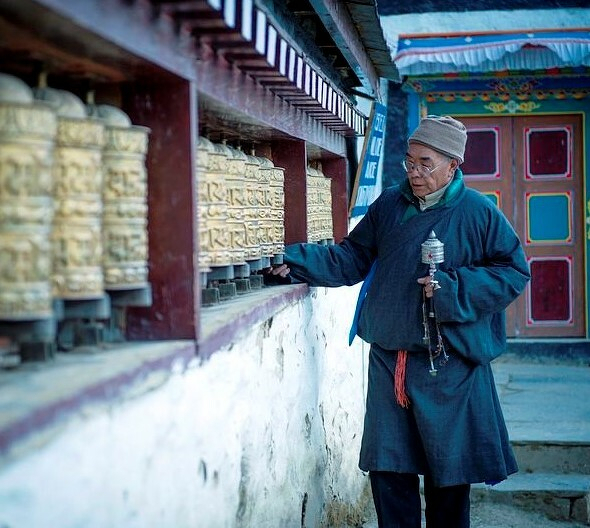
RIP Kanchha Sherpa: The mountains were also changing. Around Base Camp there was once lush grass, with yaks grazing. Gradually, it became packed earth and rocks. Peaks once white with snow turned black; glaciers melted almost before his eyes. He did not think this was global warming, though he had heard about that. The reason was simpler, that the goddess and the gods had been stepped on; and they were angry.

-
Indonesia: Over 100 ethnicities and languages populate Sulawesi. One group, the Toraja, places tremendous importance on rites for the dying and the dead; while Western cultures largely view death as final and private, Torajans see it as a communal and ongoing process requiring honor, care and celebration. In the south of the island, the Bugis culture centers on the bissu — revered priests thought to embody multiple genders and act as conduits between the human and spirit realms. Across Sulawesi’s modern inhabitants is a deep understanding of life as an unbroken line linking the ancient past with the present day.